
Mobile Occupational Health Vehicle (Mobile Health Screening Vehicle)
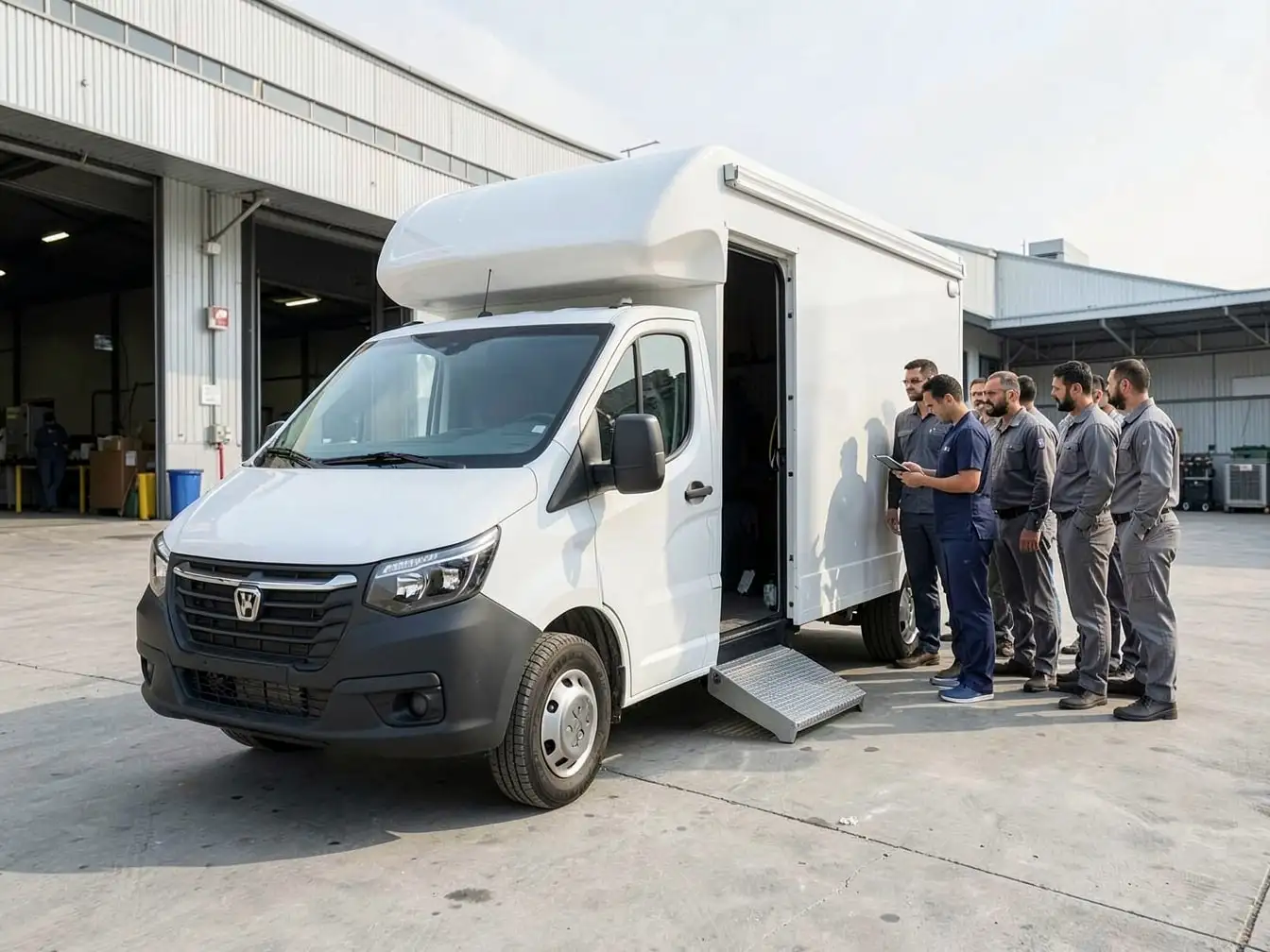
A mobile health vehicle prepared as one project from body to devices, planned to the vehicle requirements of the regulation and delivered with the devices installed.
Is a mobile health vehicle mandatory for an OSGB?
No. What is mandatory is not the vehicle but the examinations and tests the employees must have. Occupational Health and Safety Law No. 6331 places a health surveillance duty on the employer: the entry examination, the periodic examination and, depending on the nature of the job, tests such as audiometry, the pulmonary function test, the chest radiograph and the ECG.
A mobile health vehicle is one of three ways to meet this duty. The other two are sending the employees to a health facility or setting up a fixed screening unit at the workplace. Because a vehicle can screen many employees on site, often in a single day, it keeps production downtime to a minimum; that is why it is preferred at construction sites, mines and businesses with several locations.
If a vehicle is used, the ÜTS registration of the devices on it and the NDK licence and shielding requirements of the X-ray section apply separately. The vehicle itself does not remove these duties. The permit and the vehicle requirements are set out in the table below.
A workplace's own occupational health and safety unit (İSGB) cannot use a mobile vehicle; it can only set up a fixed screening unit.
Mobile occupational health vehicle regulation: the RG 31725 art. 7 requirements and how they are met on a Dentem vehicle
The OSGB receives the permit; the institution operating the device receives the NDK licence. The table below separates how each requirement is handled on a Dentem vehicle from what stays with you.
-
Vehicle type and the age limit of 15 years at most (art. 7)
On a Dentem vehicle
Settled in the vehicle and the quote
On your side
-
-
Approved modification (art. 7)
On a Dentem vehicle
Settled in the vehicle and the quote
On your side
-
-
White colour; blue fluorescent "Gezici İş Sağlığı Aracı" lettering on all four sides (art. 7)
On a Dentem vehicle
Planned in the project
On your side
-
-
Two 2 kg fire extinguishers, an emergency hammer, a seat belt cutter (art. 7)
On a Dentem vehicle
Planned in the project
On your side
-
-
Climate control and lighting in the cab, the body and the audiometry booth (art. 7)
On a Dentem vehicle
Planned in the project
On your side
-
-
Fixing to the ground with hydraulic legs during the tests (art. 7)
On a Dentem vehicle
Planned in the project
On your side
-
-
Digital tachograph and satellite tracking (art. 7)
On a Dentem vehicle
Settled in the vehicle and the quote
On your side
-
-
X-ray shielding (art. 7, 9)
On a Dentem vehicle
Planned in the project
On your side
-
-
DICOM image (art. 9)
On a Dentem vehicle
Planned in the project
On your side
-
-
NDK licence for every X-ray device (art. 7)
On a Dentem vehicle
Prepares the device information and documents and guides you
On your side
The institution operating the device receives the NDK licence
-
Engine off during the audiometry test, booth check after an accident (art. 7, 10)
On a Dentem vehicle
Planned in the project
On your side
The test is run with the engine off; the booth is checked again after an accident
-
Calibration of the devices at an authorised service (art. 5, 7)
On a Dentem vehicle
Organises the calibration of the devices it sells through an organization authorized by TİTCK; the organization issues the certificate
On your side
Having the calibration done
-
ÜTS registration (art. 5, 17)
On a Dentem vehicle
Provides the ÜTS registration details of the devices in the handover file
On your side
The ÜTS registration steps
-
Permit application
On a Dentem vehicle
Prepares the device information and documents and guides you
On your side
The OSGB receives the permit
-
Vehicle contract in İSG-KÂTİP, at least 7 days before the service (art. 7/3)
On a Dentem vehicle
-
On your side
The workplace and the OSGB confirm it on both sides
| Requirement | On a Dentem vehicle | On your side |
|---|---|---|
| Vehicle type and the age limit of 15 years at most (art. 7) | Settled in the vehicle and the quote | - |
| Approved modification (art. 7) | Settled in the vehicle and the quote | - |
| White colour; blue fluorescent "Gezici İş Sağlığı Aracı" lettering on all four sides (art. 7) | Planned in the project | - |
| Two 2 kg fire extinguishers, an emergency hammer, a seat belt cutter (art. 7) | Planned in the project | - |
| Climate control and lighting in the cab, the body and the audiometry booth (art. 7) | Planned in the project | - |
| Fixing to the ground with hydraulic legs during the tests (art. 7) | Planned in the project | - |
| Digital tachograph and satellite tracking (art. 7) | Settled in the vehicle and the quote | - |
| X-ray shielding (art. 7, 9) | Planned in the project | - |
| DICOM image (art. 9) | Planned in the project | - |
| NDK licence for every X-ray device (art. 7) | Prepares the device information and documents and guides you | The institution operating the device receives the NDK licence |
| Engine off during the audiometry test, booth check after an accident (art. 7, 10) | Planned in the project | The test is run with the engine off; the booth is checked again after an accident |
| Calibration of the devices at an authorised service (art. 5, 7) | Organises the calibration of the devices it sells through an organization authorized by TİTCK; the organization issues the certificate | Having the calibration done |
| ÜTS registration (art. 5, 17) | Provides the ÜTS registration details of the devices in the handover file | The ÜTS registration steps |
| Permit application | Prepares the device information and documents and guides you | The OSGB receives the permit |
| Vehicle contract in İSG-KÂTİP, at least 7 days before the service (art. 7/3) | - | The workplace and the OSGB confirm it on both sides |
Source: Regulation on the Procedures and Principles of Medical Tests for Employee Health Surveillance, Official Gazette 20.01.2022, No. 31725. Last updated: 11.11.2026. This information is for guidance only, as of 11.11.2026.
Mobile health vehicle for sale: body options
Panel van (15-17 m³)
Enters narrow factory yards and city streets; X-ray, audiometry booth and spirometry desk in a single body.
Minibus or pickup truck
Larger interior volume; separate waiting and examination areas.
Lorry or articulated lorry (TIR)
Separate stations for high-volume campaigns.
The body size and the interior layout are drawn according to the tests to be done and the number of employees to be screened per day.
Which tests are done in the vehicle?
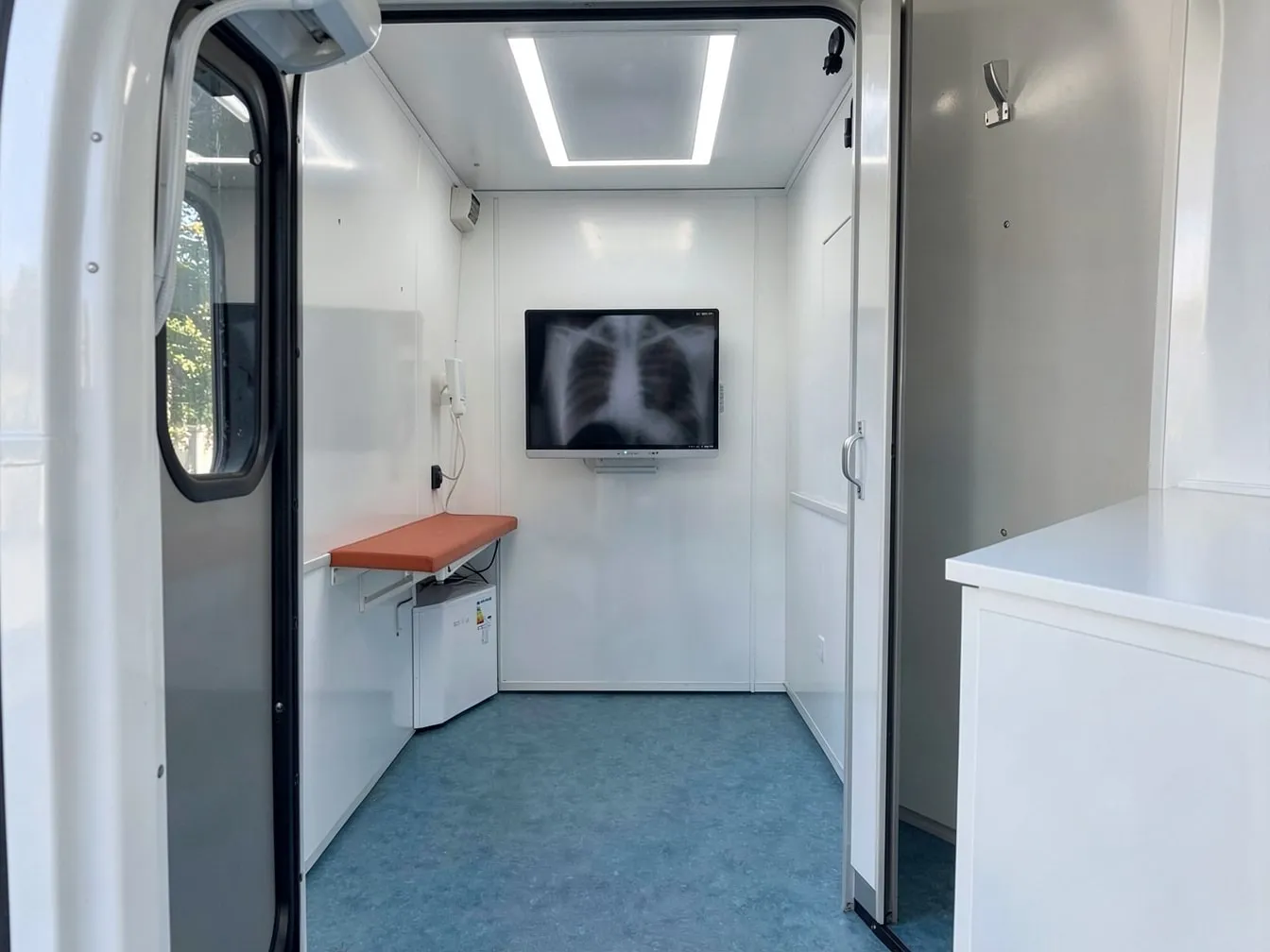
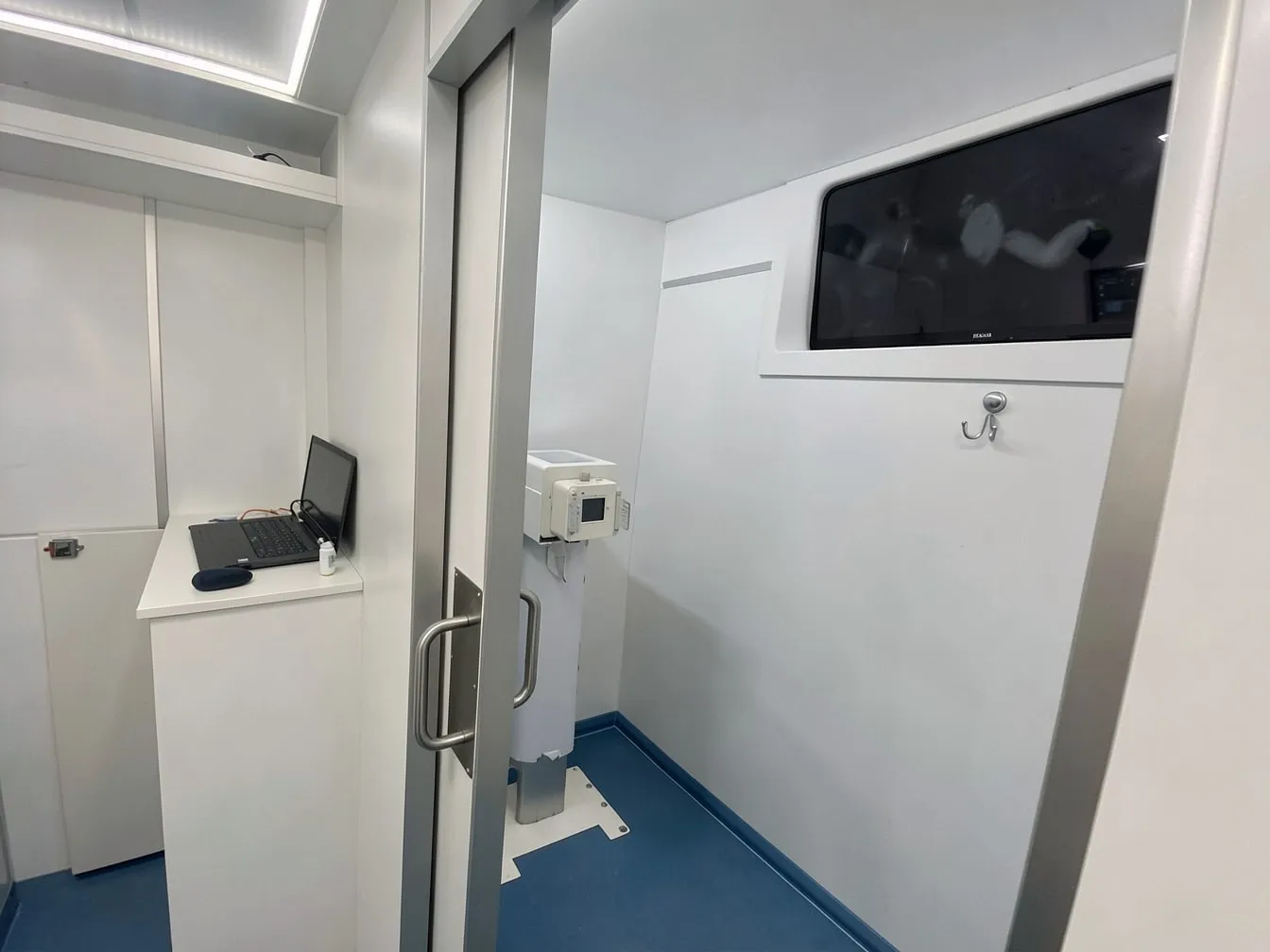
Digital X-Ray (DR)
Instant imaging with a wireless flat panel detector: chest PA, bone and joint radiographs.
Audiometry
Under RG 31725, art. 10(1)(b), hearing tests are done in a quiet booth; Maico MA 25 pure-tone audiometer.
SFT / Spirometry
Pulmonary function test, measurement of lung capacity and flow rate.
Eye Examination
Visual acuity, colour vision, autorefractometer integration.
Lead-Lined X-Ray Section
Imaging area prepared with a shielding plan calculated under NDK rules.
Hydraulic Leveling System
Hydraulic stabiliser legs for balanced imaging without vibration while the vehicle is parked.
Manufacturing and delivery process
-
1
Site survey
The tests to be done and the number of employees to be screened per day are settled.
-
2
Plan approval
The body type and the interior layout are approved as a written plan.
-
3
Body manufacturing
The vehicle is prepared according to the approved plan.
-
4
Device installation
The X-ray, booth, spirometry and other devices are installed in the vehicle.
-
5
Testing
The devices are run and checked inside the vehicle.
-
6
Training
Your team is trained in using the devices.
-
7
Handover file
Documents and registration details are delivered as a file.
One contract, one warranty
We have worked in radiology devices since 1994. The vehicle conversion and every device run under one contract, with one point of contact. Medical devices carry a warranty of at least 2 years from the invoice date and are delivered with a warranty certificate.
The handover file contains:
- ÜTS registration details of the devices
- Technical files and user manuals of the devices
- X-ray device information for the NDK licence application
- Training attendance list
A used vehicle or a new one?
Check the age of the vehicle (15 at most, RG 31725 art. 7), the approved modification, the insulation of the audiometry booth, the shielding of the X-ray section and the ÜTS registrations of the devices. In a vehicle that has been in an accident, the booth insulation and the shielding are checked again (art. 7, 10). Dentem prepares new vehicles only.
What determines the price of a mobile health screening vehicle?
There is no single figure; the quote is given item by item, based on these items:
- Body type and volume
- Test modules to be done
- X-ray and flat panel detector class
- Audiometry booth
- Climate control
- Hydraulic legs
- Training
- Maintenance contract
- Payment plan
For a product summary see the mobile health screening vehicle page, and for other solutions the OSGB solutions page.
Frequently Asked Questions
What does the regulation require of a mobile occupational health vehicle?
Under art. 7 of the Regulation on the Procedures and Principles of Medical Tests for Employee Health Surveillance (RG 20.01.2022 / 31725), the vehicle must be at most 15 years old. Its modification is approved; the vehicle is white, with "Gezici İş Sağlığı Aracı" in blue fluorescent letters on all four sides. During the tests it is fixed to the ground with hydraulic legs; it has climate control, lighting, two 2 kg fire extinguishers, a digital tachograph and satellite tracking. Every X-ray device needs an NDK licence, and the images are in DICOM format. The OSGB receives the permit; the institution operating the device receives the NDK licence. This information is for guidance only, as of 11.11.2026.
What determines the price of a mobile health screening vehicle?
The price is set by the body type and volume (panel van, minibus or pickup truck, lorry or articulated lorry), the tests to be done, the X-ray and flat panel detector class, the audiometry booth, climate control, hydraulic legs, training, the maintenance contract and the payment plan. The number of employees to be screened per day sets the interior layout, and the interior layout sets the body. Dentem prepares new vehicles only and gives the quote item by item.
What should I check when buying a used mobile health vehicle?
Check the age of the vehicle (15 at most, RG 31725 art. 7), the approved modification, the insulation of the audiometry booth, the shielding of the X-ray section and the ÜTS registrations of the devices. In a vehicle that has been in an accident, the booth insulation and the shielding are checked again (art. 7, 10). Dentem prepares new vehicles only.
If something breaks
- Medical devices carry a warranty of at least 2 years from the invoice date and are delivered with a warranty certificate.
- For detectors, audiometers and spirometers Dentem sold, we provide a loaner device during repair. Terms are written in the contract.
- The field team works weekdays from 09:00 to 18:00. The 24/7 fault line takes your call and we reply the next morning. Remote diagnosis comes first, then a site visit.
Get a Mobile Health Vehicle Price Quote
Talk to our technical team about the body type, the test modules and the device package.