
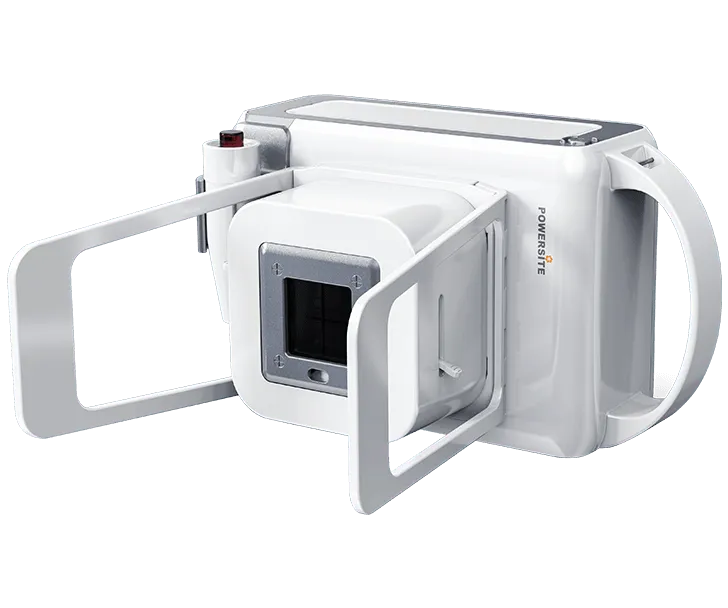
X-ray is no longer a room the patient goes to; it is a bag that goes to the patient. Over the past decade, battery technology, high-frequency generators and wireless flat panel detectors converged into portable X-ray units one person can carry and set up in five minutes.
So what actually matters when buying an “easy to carry, easy to use” system? Here are the six criteria that genuinely change the decision.
1. Pick the Category First: Handheld or Portable Generator?
Products marketed as “portable” fall into two distinct classes, and confusing them is the most common mistake.
| Handheld | Portable generator | |
|---|---|---|
| Weight | 1 – 3 kg | 3 – 7 kg |
| Typical output | 0.2 – 0.9 kW | 1.5 – 4 kW |
| Use | Hand-held or on a stand | Stand required |
| Strong at | Extremity, dental, paediatric | Chest, torso, veterinary |
| Example | Powersite PSM-HD | Poskom AirRay-20 |
The rule is simple: the thickest anatomy you will image sets your minimum power class. If your workload is mostly hand, wrist and foot, a 210–450 W handheld unit is more than enough. If you shoot routine chest PA, 900 W is the floor and a 1.6 kW class unit gives you headroom.
2. Weight: Field Weight, Not Catalogue Weight
The figure in the brochure is usually the generator body alone. What you actually carry into the field is:
- Generator body
- Battery (integrated on most models) plus a spare
- Tripod / stand
- Wireless detector and its battery
- Tablet or laptop workstation
- Carrying case
An example: the 2.9 kg Poskom AirRay-mini fits into a single shoulder bag as a complete kit. The 4.8 kg AirRay-20 needs a separate hard case and tripod. On paper the gap is 1.9 kg; on the third flight of stairs it is much more.
Practical test: during the demo, carry the unit up three floors. That is where the decision gets made.
3. kV / mA and Exposure Time
Three parameters drive image quality: kV (penetration), mA (photon quantity) and time.
- kV range: 40–70 kV covers extremity and paediatric work. For chest and torso, insist on a unit that reaches 90 kV.
- mA: higher mA delivers the same mAs in a shorter time, which directly reduces motion blur, critical with an elderly patient who cannot hold their breath, or an animal that will not stand still.
- Focal spot: a fine 0.4 mm spot gives sharper detail over a small field; 0.8–1.0 mm allows higher power. “Smaller is always better” is not true here.
4. Battery: Exposures per Charge
On a screening day, nothing is more disruptive than a battery that dies at noon. Three numbers to check:
- Exposures per charge, 150–200+ comfortably covers a daily screening programme
- Charge time, 1.5–2 hours is good; avoid 6–8 hour models that force overnight charging
- Operation while charging, support for 12 V vehicle power or a generator feed is a game changer in mobile units
5. Detector Pairing, The Step Most People Skip
A portable X-ray generator produces no image on its own; it needs a flat panel detector. Compatibility points:
- Triggering method: a panel with AED (automatic exposure detection) needs no cable sync with the generator, which significantly simplifies field setup
- Panel size: 14×17″ means lighter, 17×17″ means more coverage
- Battery and ruggedness: a panel that goes into the field must be shock and liquid resistant
For a detailed comparison see Wired vs Wireless Flat Panel Detectors. On the product side, iRay Mars 1417V and Mars 1717V are the panels most often paired with portable generators.
6. Radiation Safety and Regulation
Portability does not mean compromising on radiation safety, if anything, the operator works closer to the beam, so precautions increase.
- Remote triggering: wireless remote or WiFi triggering to put distance between operator and beam
- Backscatter shield: treat as mandatory on handheld units
- Personal dosimetry: for the whole field team
- Collimation: tightening the field is the cheapest improvement to both dose and image quality
In Türkiye, installation and use of medical X-ray equipment is subject to authorisation by the Nuclear Regulatory Authority (NDK). Because X-ray units contain no radioactive source, they emit nothing when powered down, which makes storage and transport rules markedly simpler than for radioactive-source systems.
The AI-Assisted Generation
Two features stand out in units released after 2025:
- AI dose reduction, algorithmic suppression of noise and scatter, aiming to deliver the same diagnostic quality at a lower dose
- AI pre-read, preliminary findings within seconds of exposure; useful for triage in screening programmes
Our own three portable systems, the handheld Powersite PSM-HD series, the portable generator Poskom AirRay-20, and the ultra-light Poskom AirRay-mini, map onto different priorities in this list: PSM-HD leads on weight and freedom of movement, AirRay-20 on power class, and AirRay-mini on AI-assisted workflow. The most visible example of this class is AirRay-mini, which took two CES 2025 awards; we covered that in a separate article. A reminder: AI output is clinical decision support; final diagnosis rests with the physician.
Quick Decision Table
| Your need | Recommended class | Product |
|---|---|---|
| Extremity-heavy, long handheld sessions | Handheld 210 W, 0.4 mm spot | PSM-HD210S5 |
| Mixed: extremity + shoulder/thick tissue | Handheld 450 W | PSM-HD450 |
| High-volume chest screening, still handheld | Handheld 900 W | PSM-HD900 |
| Maximum portability + AI workflow | Ultra-light portable | AirRay-mini |
| Routine torso/chest + veterinary | 1.6 kW portable generator | AirRay-20 |
| Fixed installation inside a vehicle | Mobile vehicle solution | Mobile occupational health vehicle |
Conclusion
Choosing an “easy to carry, easy to use” X-ray unit is not the same as buying the lightest one. The right order is: define the anatomy you will image → fix the minimum power class → pick the lightest, longest-battery model within that class → verify detector compatibility → budget the radiation safety equipment.
Browse all our X-ray equipment or ask our team for help with model selection:
- Phone: +90 (216) 504 00 47
- WhatsApp: +90 533 604 36 60
- Contact form
Dentem Health has supplied, installed and serviced radiology systems since 1994.